Are you wondering whether to choose Opencart or WooCommerce? Then don’t miss our blog. In this article, we will give you a comprehensive Opencart vs WooCommerce comparison to help you choose the best one for your e-commerce store.


Introduction
Nowadays, the eCommerce industry is dramatically growing. Online shopping provides a convenient environment for customers, so they tend to make purchases from home instead of going to local shops. There is no denying that the boom in online shopping has created many advantages. However, there are still many challenges for retailers.
Therefore, website owners need to choose a reputable eCommerce platform that can ensure the quality of various aspects of their online store, including security, user experience, traffic, conversion, revenue, and much more.
Opencart and WooCommerce are considered the two most famous eCommerce platforms in the market. Both come with plenty of powerful features that allow you to easily build an online store. However, which platform is better? In today’s blog, we will compare Opencart vs WooCommerce to show the detailed differences between them so that you can choose the best platform for your website.
Now, let’s dive into the following sections.
Opencart vs WooCommerce: Brief background
Opencart

Opencart is one of the most well-known open-source content management systems, specially designed for e-commerce websites. It is built on PHP, a MySQL database, and HTML components. This platform has been around for 20 years and is regarded as the perfect solution for those who are going to build a professional online store because of its high-quality dedicated features. This platform is created for small and medium businesses. It is very simple and easy to install. In addition, you can manage multiple stores from a single place and even choose different themes for various stores.
WooCommerce

WooCommerce is another serious competitor of Opencart. It is also an open-source e-commerce solution, built as a powerful WordPress plugin. It was built by Mike Jolley and James Koster in 2011. In 2015, WooCommerce and its developer WooThemes were both acquired by the parent company of WordPress – Automattic. In January 2020, there were an estimated 3.9 million websites using WooCommerce.
Main features
Let’s get down to our head-to-head comparison by exploring how Opencart vs WooCommerce stack up against each other in terms of features. Which solution will offer more diverse features?
Opencart
Similar to other powerful e-commerce platforms, Opencart also has great features that help you easily manage your online store. A list of core features includes:
- Unlimited Products, Categories, and Manufacturers
- Support Multi-Currency and Multi-Language
- Product Reviews and Ratings
- Automatic Image Resize
- More than 20 Payment Gateways
- Over 8 Shipping Methods
- Manage multiple shops
- Meta tags and descriptions for better SEO
WooCommerce
Like Opencart, WooCommerce provides you with a substantial feature set. This platform is used by over 30% of all online stores for its excellent features.
- Automatic Taxes Calculation
- Shopping Cart Behavior
- Reduce Page Loading time
- Easily Add/Manage Products
- Product Types and Variables
- Inventory Management
- Multiple Shipping Methods
- Taxes based on Geography
- Simplified Coupon System
- Product Reviews and Ratings
- Owner Verification
- Reporting
- Powerful analytics
Ease of use
This is one of the vital criteria you need to consider when starting an online store. A platform that is designed with an easy-to-use interface will help you easily set up and operate. In addition, it will save you a lot of time learning how to use it.
Opencart
Opencart is not a plugin, so the process of installing and setting up this platform will definitely be a little more complicated than WooCommerce. You are required to have some technical knowledge to start if you choose the manual installation process. First of all, you have to download the software, then you need to create the database before running the installation. If this process confuses you, we advise using the one-click auto installation option.
In addition, this platform has a user-friendly interface because it is specially designed for eCommerce websites. Opencart’s administration on the left side of the store is where you can upload images, add products, keep track of customers, access multiple features, install extensions, monitor sales, manage customer groups, etc.

WooCommerce
On the other hand, WooCommerce is a plugin for WordPress, so it only takes a few clicks to install and set up this platform like other plugins. After the plugin has been activated, you can start adding your products, creating categories, tags, etc. from WooCommerce’s dashboard.
However, WooCommerce is a self-hosted open-source platform. Thus, you have to manage updates, keep backups, and do everything by yourself. To do these tasks, you need to have a certain level of technical knowledge. And sometimes, you have to write some code and use web design skills to modify and customize your website layout.

Designs and templates
If you want to make a strong impression on your customers at first sight, it is important to choose beautiful designs for your website. In addition, using an attractive appearance for your website not only helps your website look professional but also builds trust with your customers. Now, let’s see how Opencart and WooCommerce designs compare.
Opencart
There are over 500 free and paid themes on Opencart’s marketplace. Each theme has many flexible layouts, customization options, and powerful features. Opencart also provides you with a beautiful demo so that you can see how your website looks before making a purchase.

WooCommerce
As you can see in the screenshot below, the WooCommerce store only has a total of 45 themes. There are three free themes, 14 storefront themes, and 39 responsive themes. The default theme of WooCommerce is free, but if you want to expand its functionality by purchasing the extension bundle, the price is $69 for a one-time payment.
Although the number of themes provided by WooCommerce is smaller than Opencart’s, there is a huge collection of free eCommerce themes in the WordPress repository that completely support WooCommerce.

Payment gateways
There is no denying that providing various payment gateways will help you improve the user experience of your online store. Therefore, you need to choose a platform that supports multiple payment methods. Luckily, both Opencart and WooCommerce offer plenty of tools that help you to do that.
Opencart
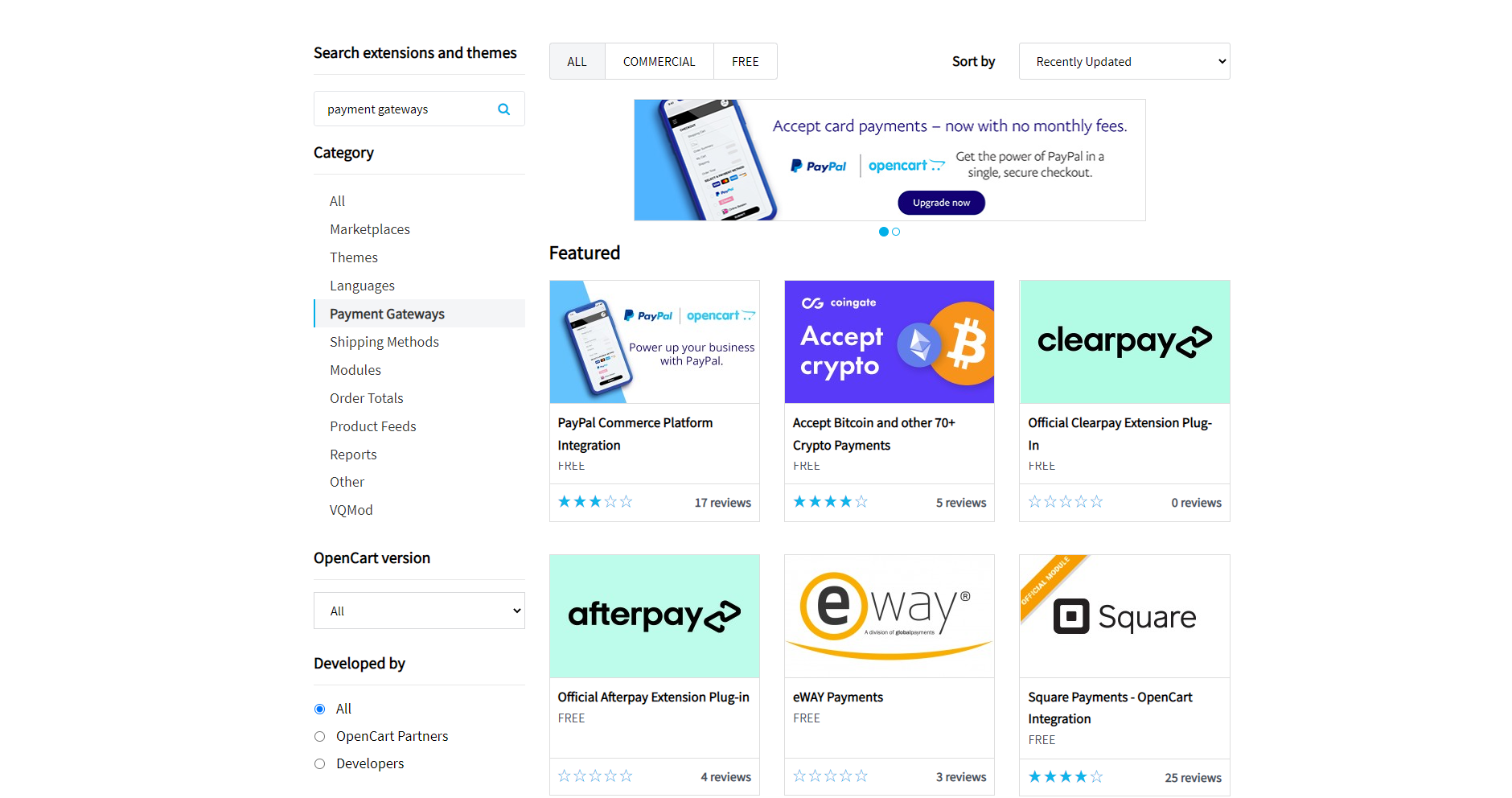
Currently, Opencart supports 36 different payment gateways and over 900 payment methods via its extension marketplace. This platform offers many popular payment gateways including PayPal, Amazon Pay, Paypoint, Paymate, Free checkout, eWay Payment, LIQPAY, Card connect, etc.
If you want to use payment methods that are available on the Opencart Extension marketplace, you need to install the supported extensions. Moreover, this platform also provides additional features such as payment method in checkout and payment method in the order history.
WooCommerce
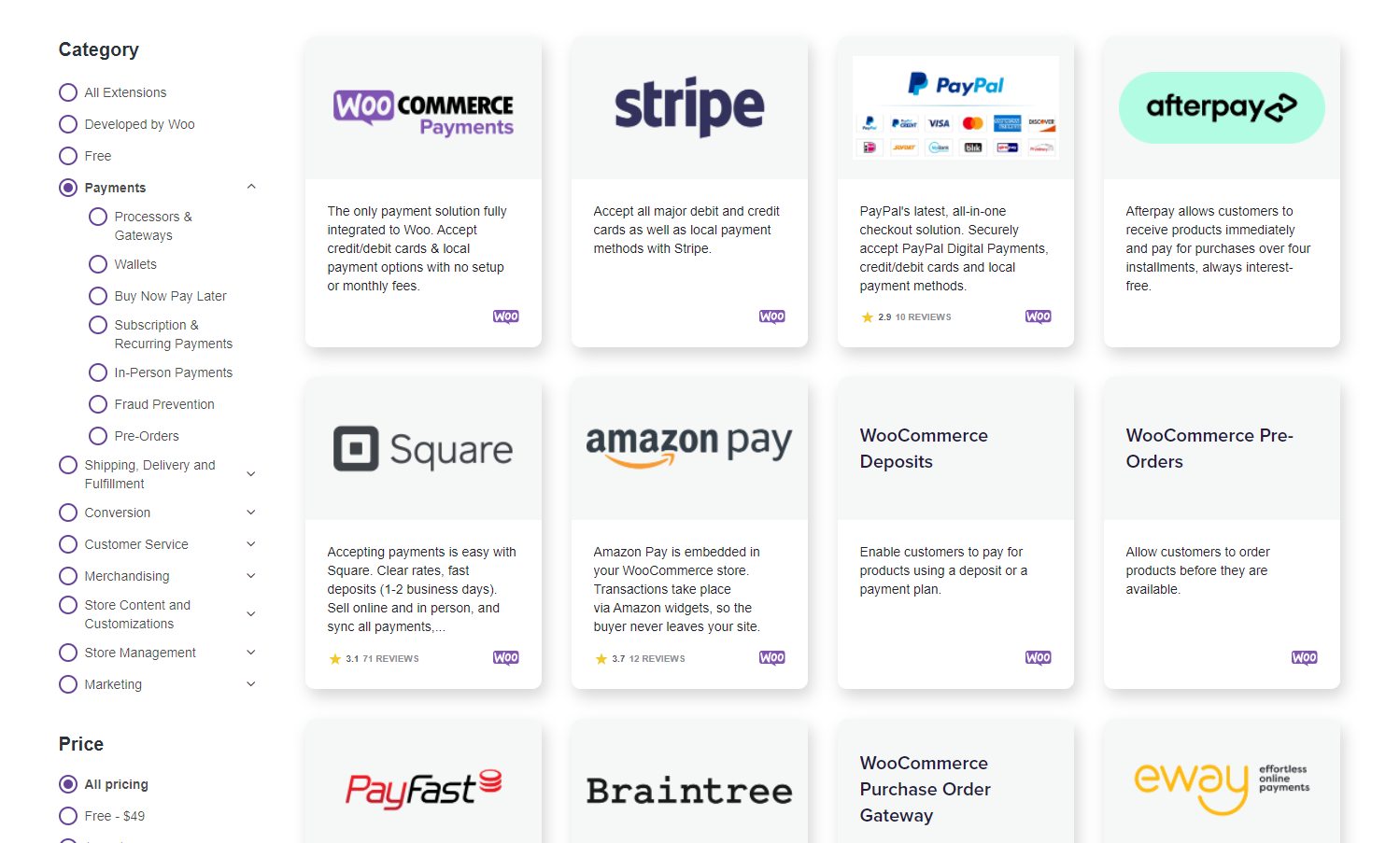
WooCommerce provides you with the ability to access over 100 payment gateways. Some great payment gateways integrated with WooCommerce include PayPal, Amazon Pay, and Stripe. One of the advantages is that these payment gateway plugins are available in the WordPress ecosystem. All you need to do is install one of them from your WordPress dashboard and then allow your customers to check out and pay via various payment gateways.
These tools will improve the shopping experience on your website by allowing your customers to check out directly instead of leaving your website.
Pricing
Opencart
One of the best things is that the Opencart platform is completely free to download. However, to run a professional online store, you at least need a hosting plan and a domain name for your store. The price of hosting plans for Opencart start at $5/month. And you pay $10/year for a domain name.
In addition, you may need to purchase an SSL certificate, depending on the needs of the store. The price of an SSL certificate will vary.
WooCommerce
Similarly, WooCommerce is also a free plugin, so you can download it directly from your WordPress dashboard. Additionally, there are no particular pricing plans or packages offered by WooCommerce. But you have to pay for the essential hosting, domain name, powerful extensions, and plugins to expand the functionality of your online store.
We will provide you with estimated prices for each element you will have to pay for if you want to run a high-quality online store.
| WooCommerce cost | Cost estimate |
| Themes | WooCommerce themes |
| Plugins | Free |
| Extensions | Free + transaction fees |
| Hosting | From $311.40/year with shared hosting |
| Domain Name | From $12.99/year (.com site) |
| Security | Free |
| Developer fees | Free |
| Annual cost | $324.39 + transaction fees |
Customer Support
Opencart
Opencart offers the following support options: service tickets, official documentation, a blog, and video tutorials. You can easily choose one of them to find a solution to your problem. In addition, Opencart also has a big forum with more than 110 000 registered members and 550 000+ posts where you can easily get community support to troubleshoot your issues. In general, Opencart’s Community Forum is considered the main type of customer support service of this platform.
Additionally, Opencart provides you with a dedicated support service that costs $120 per month. This plan is used whenever you want to consult a specialist on your store’s technical problems, upgrades, and extension installations. By using this service, your questions are guaranteed a response within 24 hours, and expert consultants that will advise you on your technical questions.

WooCommerce
In contrast, WooCommerce doesn’t offer a dedicated support service. Therefore, it is difficult for you to handle technical issues. Nevertheless, you can still get support from your website hosting company.
When using WooCommerce, you always have to be ready to take responsibility for solving issues by yourself. In addition, you can find detailed documentation, tutorial videos, and articles that can help you tackle some prevalent problems.
Advantages and disadvantages
After breaking down all of these aspects — features, ease of use, designs and templates, payment gateways, price — it’s time to see the strengths and weaknesses of Opencart vs WooCommerce.
Opencart
| Advantages | Disadvantages |
|
|
WooCommerce
| Advantages | Disadvantages |
|
|
Opencart vs WooCommerce: Who is the winner?
We have just provided a side-by-side comparison between WooCommerce and Opencart. Each platform has its own good points and drawbacks. Therefore, to conclude, which is the best platform in this battle? The answer to this question will lie in your requirements.
If you have previous development experience or some technical knowledge, then using Opencart is a perfect choice for your website. This platform will help you build a functional and professional-looking eCommerce website, plus the rich features allow you to create a truly unique website. In addition, Opencart is also suitable for those who have little or no budget. However, if you want to use premium features, extensions, and themes to take your website to the next level, you will need to put some cash down.


In contrast, you can use WooCommerce to start building your unique site. This platform is also highly customizable, so it is a great solution for eCommerce site owners with some amount of technical knowledge. Besides, WooCommerce is good for large eCommerce sites, since it is scalable and can manage an unlimited number of products without making your website slow.
Moreover, although WooCommerce itself doesn’t offer as many extensions as Opencart, this platform provides you with a huge number of WordPress eCommerce plugins. Hence, you can take advantage of these tools to improve the shopping experience and boost your online store.
By the way, you might want to see a detailed comparison between Bigcommerce vs WooCommerce. Last but not least, if you want to explore more beautiful free eCommerce WordPress Themes, don’t hesitate to visit our website.